When you're planning your next journey, choosing between two modes of transportation shapes the entire travel experience. Several factors like cost effectiveness, travel time, and convenience determine whether bus or train works better for your specific trip.
Whether you're organizing group travel for corporate events, school trips, or family outings, Chicago charter bus services offer a practical alternative to rail travel that combines flexibility with comfort. Let's examine this direct comparison between these transportation methods across the factors that matter most to travelers.
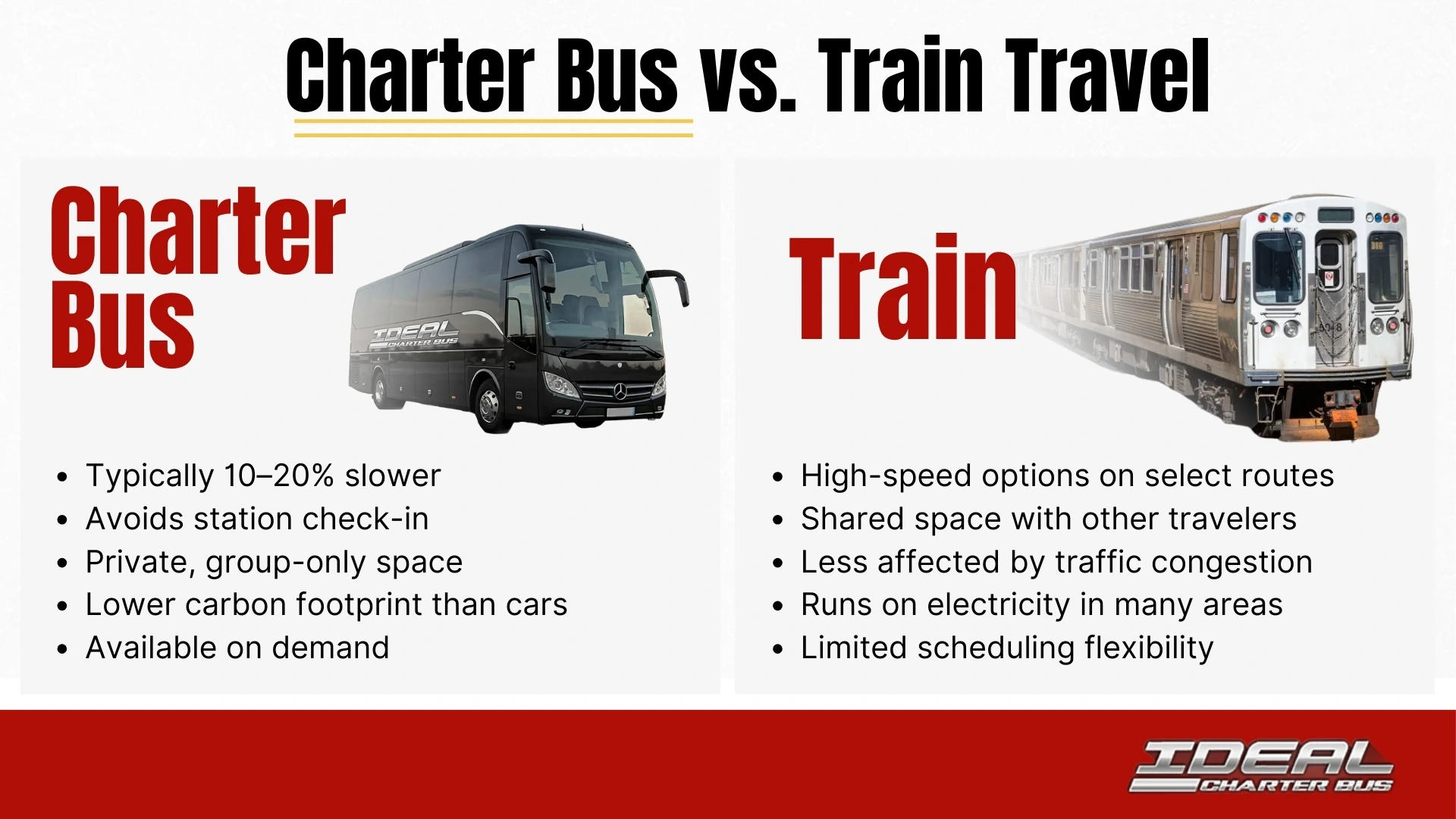
Bus Travel Overview
Bus travel has come a long way from its basic beginnings. Modern buses and charter services now offer comfortable, amenities-rich experiences. Long-distance buses provide private, customizable travel for groups, unlike public transportation with fixed bus lines and schedules. Charter services tailor routes to your needs, with professional drivers handling navigation.
Pros of charter buses:
- Fully flexible schedules and routes
- Door-to-door service, no extra transport needed
- Wi-Fi, power outlets, onboard restrooms
- Trained professional drivers
- Cost-effective for groups per passenger
- Easy group coordination with everyone on one bus
- Lower bus ticket prices than train tickets for groups
Cons of charter buses:
- 10–20% longer travel time vs. trains
- Possible traffic delays during peak hours
- Speed affected by road conditions
Train Travel Overview
Train travel offers a unique experience with dedicated train networks, central stations, and scheduled services between major cities. Passengers enjoy scenic views, spacious seating, and the freedom to move around. Modern trains often feature dining cars, lounges, and comfortable seating for long journeys. Stations are usually downtown, and high speed trains cut travel time on major routes.
Pros of train travels:
- Faster travel on long distance routes, especially with high speed trains
- Unaffected by traffic congestion
- Spacious seating and freedom to move around
- Central train stations for easy city access
- More reliable schedule than bus travel
Cons of train travels:
- Fixed schedules with limited flexibility
- Higher train ticket prices for groups
- Limited coverage in areas without train stations
- Often requires extra transport to final destination
- Extra fees for luggage, seat selection, or reservations
Bus vs. Train: A Side-by-Side Comparison
The choice between bus and train travel affects everything from your budget to your arrival time. This direct comparison shows how these transportation methods stack up across factors that shape your travel experience.
Flexibility and Scheduling
Charter buses offer full control over departure times, routes, and stops. Need to pick up passengers at multiple points or adjust return times? You can customize your bus trip to fit your group’s needs. This flexibility is ideal for corporate events and school trips, as bus services adapt to your schedule — not the other way around.
Trains operate on a more reliable schedule with predetermined departure times and train routes. While this creates reliability for regular commuters who need predictable timing, it constrains groups who miss a train and must wait for the next scheduled departure. The train network doesn't deviate from established paths, which means you'll need additional transportation to reach destinations not directly served by train stations.
Travel Time and Reliability
Travel time by bus depends on distance, road conditions, and route planning. Long distance travel by bus typically requires 10-20% more time than equivalent train trips, primarily due to highway speed limits and potential delays from traffic congestion. However, buses can take the most direct route to your final destination without requiring transfers or additional connections at bus stations.
Trains tend to be faster than buses on long distance routes, especially with high-speed trains. They avoid traffic congestion, making schedules more reliable and reducing delays — particularly on routes over 200 miles.
Comfort and Amenities

Modern buses prioritize passenger comfort with features designed for extended travel. The inside of a charter bus creates a mobile workspace or relaxation space that standard transportation can't match.
These amenities become especially valuable for long journeys:
- Reclining seats with proper back support and adjustability
- Ample legroom preventing cramped comfortable seating
- Onboard restrooms eliminating frequent stops
- Climate control maintaining comfortable temperatures
- Wi-Fi connectivity for productivity or entertainment
- Power outlets at each seat for devices
- Entertainment systems for longer trips
- Large windows with UV protection
- Storage space for luggage and personal items
Trains offer spacious seating with ample legroom, often 36 inches or more. Passengers can move freely, visit dining cars, and enjoy scenic views through large windows. The smooth ride makes it easier to read or work, and the freedom to move helps reduce deep vein thrombosis risk on long journeys.
Route Coverage and Accessibility
Buses reach any location accessible by road, covering far more destinations than train networks. They offer door-to-door service, eliminating the need for extra transport from stations. Buses easily access rural, suburban, and off-network venues, with bus stations more widely distributed than train stations
Trains connect major cities and key corridors but offer limited access to rural and suburban areas. Stations are usually downtown, but many destinations require additional transport. The fixed rail network restricts access to areas without train services.
Environmental Impact
Modern buses offer strong fuel efficiency per passenger. With high bus capacity, a full charter bus emits about 0.14 kg of carbon emissions per passenger mile — less than multiple cars making the same trip. Consolidating travelers into one vehicle lowers the environmental footprint, traffic congestion, and parking demand. Many long distance buses now use alternative fuels and efficient engines to further reduce their environmental impact.
Trains typically emit around 0.09 kg of carbon emissions per passenger mile. When powered by renewable energy or alternative fuels, especially electric trains, rail travel becomes one of the most environmentally friendly transportation methods for traveling long distance. However, impact depends on energy source and passenger load.
Safety Considerations
Charter bus companies follow strict safety standards, including regular inspections and professional maintenance. Drivers receive thorough training, background checks, and certification. Modern buses feature three-point seat belts, advanced braking, stability controls, GPS tracking, and marked emergency exits. Bus vs train safety comparisons show both are reliable when properly maintained.
Rail travel has strong safety records, with dedicated tracks that avoid collisions with cars. Trains are less affected by road or weather conditions, and their fixed routes reduce accident risks. While generally safe, the train or bus safety debate often depends on specific routes and operators.
Bus vs. Train Cost Comparison: Breaking Down Real Numbers
Real numbers help clarify the difference between bus and train costs for your trip. Charter bus rental prices provide predictable, all-inclusive costs that help you save money while simplifying budgeting for groups. Here's what you can expect:
- 56-passenger motor coach: $1,300-$1,450 for a full day (roughly $23-26 per person at capacity).
- 39-passenger executive coach bus: $1,150-$1,300 for 10 hours (about $29-33 per person).
- 22-passenger mini bus: $1,050-$1,250 for a full day (approximately $48-57 per person).
These bus ticket prices include professional drivers, fuel, insurance, and all onboard amenities with no hidden fees or surge pricing.
Train ticket prices vary by route, distance, class, and booking time—typically $20–$50 for short trips, $80–$200 for longer ones. Added costs include luggage, seat selection, and booking fees, often raising prices by up to 20%. For 30 passengers on a 150-mile trip at $60 each, train travel totals $1,800 before fees. A charter bus costs $1,150–$1,300, saving $500–$650 with more schedule control and door-to-door service.
Factors to Consider When Choosing Your Transportation

The right transportation choice depends on your specific situation and personal preferences. Before deciding between bus and train travel, evaluate these key factors:
- Group size: Buses make more sense once you're moving 10+ people, offering better coordination and often better per-person pricing than individual train tickets for larger groups.
- Destination accessibility: Consider whether your final destination is directly served by train stations or if you'll need additional transportation after arriving by rail.
- Schedule flexibility: Events requiring specific departure times, multiple pickups, or adjustable return schedules favor the customizable nature of bus services.
- Comfort priorities: Multi-hour long journeys where passenger comfort affects productivity or enjoyment justify investing in transportation with proper amenities and space.
- Environmental concerns: Both buses and trains reduce emissions compared to multiple cars, though trains edge ahead in per-passenger environmental footprint on well-utilized routes.
- Arrival timing: Groups needing everyone to arrive simultaneously for events, meetings, or activities benefit from the unified schedule that bus travel provides.
Your choice between these transportation methods ultimately depends on weighing convenience against speed, flexibility against fixed schedules, and group coordination against individual ticket pricing. Most travelers find that for group trips, buses deliver better value through improved logistics and cost effectiveness.
Choose the Right Transportation for Your Next Journey
The bus or train decision comes down to what matters most for your specific trip. Individual travelers on established train routes between major cities may prefer trains for speed and central locations. Groups needing flexibility, coordination, and cost effectiveness will find bus services deliver better overall value through improved logistics and savings.
Ideal Charter Bus serves Chicago and surrounding areas with a complete fleet of vehicles sized for groups from 14 to 56 passengers, with professional drivers and transparent pricing that make group transportation straightforward. Contact us today for a free quote and discover how simple moving your group can be.
Ready to Book Your Church Retreat Transportation?
Let us handle the driving while you focus on creating a meaningful spiritual experience. Serving the greater Chicago area with reliable, comfortable group transportation.